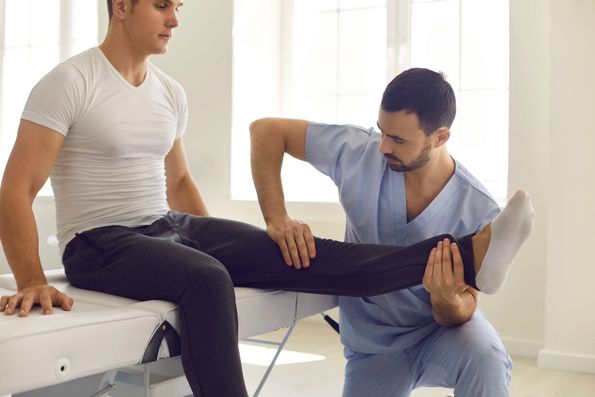
Two players enter with similar injuries to their knees. One leaves with a physical therapy program and returns to the game within ten weeks. The other is scheduled for surgery. Both choices were correct. There is nothing neat about sports injuries where one either performs an operation or does not, and those who say otherwise have missed out on some essential questions.
This blog helps to know about the necessity and situation for surgical or non surgical treatment.
The Question Is Rarely Just About The Injury
What ends up deciding the approach is a combination of things. The structure that has been damaged, obviously. But also the age of the patient, what they need to go back to, how stable the joint feels, and how much time they realistically have for rehabilitation.
A forty-two-year-old who plays badminton on Sundays and a nineteen-year-old district-level footballer can present with identical MRI reports and still be advised differently. The footballer’s knee has to survive pivoting and sudden direction changes for another decade. The badminton players may not.
This is why a proper centre for sports injury assessment takes longer than a five-minute look at a scan. Examination of the joint under the hand tells you things the MRI cannot, particularly about stability.
Injuries that usually do well without surgery
A large share of sporting damage settles with conservative care. Non surgical treatment is generally the first line for:
- Grade one and two ligament sprains of the ankle, knee or wrist
- Muscle strains, including hamstring and calf tears that have not fully ruptured
- Most rotator cuff tendinopathy, and partial-thickness cuff tears
- Tennis elbow and golfer’s elbow
- Stress reactions in bone, caught early
- Isolated MCL injuries of the knee, which have a very good blood supply and heal well
- Small, stable meniscus tears in the outer zone
The programme itself is more involved than rest. It combines a short period of protection, then graded loading, then strength work, then sport-specific drills. Injections have a place, though a limited one. Platelet-rich plasma and corticosteroid both get used, but a steroid into a tendon repeatedly is a bad idea and any honest surgeon will say so.
Around sixty to seventy per cent of sports injuries presenting to clinics never require an operation at all.
Where non surgical treatment tends to fall short
Some structures do not heal on their own regardless of how disciplined the patient is. The ACL is the most quoted example. It sits inside the joint bathed in synovial fluid, which prevents a clot from forming across the torn ends, so a complete tear simply does not knit back together.
Similar difficulty applies to:
- Complete tendon ruptures, such as Achilles or patellar tendon
- Bucket-handle meniscal tears that lock the knee
- Displaced fractures around a joint surface
- Loose fragments of cartilage floating inside the joint
- Recurrent shoulder dislocations with a torn labrum
- Full-thickness rotator cuff tears in a younger, active person
Persisting with non surgical treatment in these situations wastes months and sometimes causes secondary damage. An unstable knee that keeps giving way grinds its own meniscus and cartilage down in the process.
Signals that push the decision toward surgery
- The joint gives way, locks, or catches during ordinary walking
- Pain and swelling that return every time activity is resumed, after a full course of physiotherapy
- Scans revealing a complete tear with retraction
- A professional sports player on a set season schedule
- Inability to return to normal strength level after three months of supervised physical therapy
This one needs to be repeated. Three to six months of proper and supervised physical therapy is a fair test. Three weeks of lazy physical therapy is not.
What A Good Sports Injury Centre Is Meant To Do
The real advantage of a proper centre for sports injury doesn’t come from the operating room, but from the ancillary factors around it. Proper clinical assessment, imaging done in the context of that assessment, physical therapy all conducted in one place, and the application of a return-to-play protocol based on testing rather than on guesswork.
Return-to-play testing is where most centres fall short. Before releasing an injured player back into action, it is crucial to compare strength in the affected leg with the unoperated leg, and hop tests should show 90% symmetry in performance.
Patients looking for structured sports injuries treatment should ask about this specifically. It separates a surgical service from a genuine sports medicine service.
Recovery timelines, honestly stated
Nobody enjoys hearing these numbers, but planning around them is better than being surprised.
Conservative care. Muscle strains, three to eight weeks. Ligament sprains, two to eight weeks depending on grade. Tendinopathy, often three months or longer, since tendon remodelling is slow.
After surgery. ACL reconstruction, nine to twelve months before returning to pivoting sport. Rotator cuff repair: four to six months. Achilles repair, six to nine months. Arthroscopic meniscal trim, four to eight weeks, though a meniscal repair takes considerably longer because it needs to heal rather than merely be tidied up.
Surgery is not the shortcut. It is often the longer road, chosen because it leads somewhere the other road does not.
Questions worth asking before you agree to anything
- What happens if I choose non surgical treatment and it does not work? Have I lost anything?
- Is this operation restoring stability, or relieving pain, or both?
- How many of these do you do in a year?
- What does week one look like, and week twelve?
- Who supervises the rehabilitation, and where?
The Middle Path
The two approaches are not opposed. Even planned surgery is preceded by what is called prehabilitation, where the joint is settled and the muscles strengthened first, because operating on a stiff, swollen knee produces a worse outcome. And every operation is followed by months of the same physiotherapy that non surgical treatment would have involved anyway.
Put simply, rehabilitation is the constant. Surgery is the variable added when the anatomy will not heal by itself.